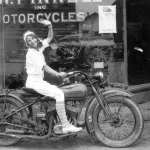

Vivian Bales, born January 19, 1908, in Wacissa, Florida, and raised in Albany, Georgia, was a pioneering female motorcyclist who became known as the “Enthusiast Girl” and the first motorcycle magazine cover girl. Her remarkable 5,000-mile solo journey across the United States in 1929 on a Harley-Davidson cemented her legacy as one of the earliest and most inspiring female long-distance riders. Below is a detailed summary of her motorcycle rides, based on available information, focusing on her significant achievements and the context of her adventures.


Early Life and Introduction to Motorcycling
Vivian Bales grew up in Albany, Georgia, after her family moved there around 1910. After graduating high school in 1926, she worked as a seamstress and dance instructor, which provided her with extra income. At age 17, inspired by a desire for adventure and the affordability of motorcycles compared to traveling by horse, she purchased her first motorcycle, a Harley-Davidson Model B single-cylinder (350cc) in 1926. At 5’2” and 95 pounds, Vivian faced physical challenges, as she was unable to kick-start the bike on her own. A friend who rode motorcycles taught her how to crank the bike, and she quickly taught herself to ride, despite societal norms that discouraged women from such activities. Her determination to defy expectations fueled her passion for motorcycling, which she described as the “key to the whole United States.”
First Major Ride: Albany to St. Petersburg (1926)
Vivian’s first significant motorcycle trip occurred shortly after she learned to ride in 1926. Accompanied by her high school friend Josephine Johnson, who also owned a motorcycle, Vivian rode over 300 miles from Albany, Georgia, to St. Petersburg, Florida, to visit Josephine’s sister. This journey was notable for its time, as women riding motorcycles were rare, and the roads were often unpaved and challenging. The local Harley-Davidson dealer in St. Petersburg was so impressed by their adventure that he arranged for their story to be featured in the St. Petersburg newspaper and later in the Atlanta Journal. This publicity sparked Vivian’s ambition for longer rides and established her as a local figure known as “the girl with the motorcycle” in Albany.
The Epic 5,000-Mile Solo Journey (1929)
Inspired by her initial trip and eager for greater adventure, Vivian traded her Model B for a 1929 Harley-Davidson 45 Twin D (740cc), which she affectionately called a “real honey.” In 1929, at age 20, she planned a solo cross-country trip and wrote to Hap Jameson, editor of The Harley-Davidson Enthusiast magazine, to share her intentions. Although Harley-Davidson did not officially sponsor her journey, they named her the “Enthusiast Girl” and provided her with two sweaters emblazoned with the title. They also arranged for Harley-Davidson dealers, Rotary Clubs, and others along her route to offer accommodation, fuel, and maintenance, which supported her ambitious undertaking.
Journey Details
- Start and Duration: Vivian began her trip on June 1, 1929, from Albany, Georgia, and completed it over 78 days, covering approximately 5,000 miles.
- Route: She rode to the Harley-Davidson factory in Milwaukee, Wisconsin, as a primary destination. On her return, she traveled through Canada, Manhattan, the Carolinas, and Washington, D.C., meeting local dignitaries and Harley-Davidson dealers along the way.
- Notable Encounters: In Washington, D.C., Senator William J. Harris arranged for Vivian to meet President Herbert Hoover. She met him wearing her signature all-white riding outfit, which included breeches, a shirt, helmet, socks, and a sweater with “The Enthusiast Girl” written across the chest. This meeting highlighted her growing fame and the significance of her journey.
- Challenges: The journey took place before the interstate highway system, meaning Vivian navigated rough, often dirt or gravel roads. At 65 miles per day on average (5,000 miles over 78 days), her pace was steady but demanding, given the bike’s limitations and the era’s road conditions. Her small stature made handling the 740cc motorcycle challenging, especially since she couldn’t kick-start it herself and likely relied on roll-starting or assistance at stops.
- Publicity: Vivian’s ride was widely covered by local newspapers across the U.S. and featured in the May, November, and December 1929 issues of The Harley-Davidson Enthusiast. She chronicled her experiences in an article for the magazine, expressing her pride in completing the journey alone and her frustration with societal views that women shouldn’t ride motorcycles. She wrote, “Hearing that no girl should ride one irritates me greatly. When I hear that, my blood boils.”
Significance
Vivian’s 5,000-mile ride was groundbreaking for several reasons:
- It challenged gender norms in an era when women were discouraged from riding motorcycles due to stereotypes about their physical capabilities and societal roles.
- Her journey showcased the reliability of Harley-Davidson motorcycles and helped promote the brand, earning her the admiration of company founder Arthur Davidson, who nicknamed her “The Georgia Peach.”
- As the first woman to appear on the cover of The Harley-Davidson Enthusiast (May and November 1929), she became an icon for female motorcyclists and inspired others to take up riding.
Stunt Riding and Later Life
Following her cross-country journey, Vivian continued motorcycling and performed as a stunt rider at motorcycle races in Tallahassee, Florida, further showcasing her skill and daring. Despite her passion, she never purchased another motorcycle after her 1929 Harley-Davidson 45 Twin D. She later married William Faison, adopted three children, and lived a long life, passing away on December 23, 2001, at age 92 in Albany, Georgia. Her funeral was marked by a procession of Harley-Davidson motorcycles, organized by Flint River Harley-Davidson, fulfilling her request and honoring her legacy as a free-spirited rider. Vivian herself stated that her Harley-Davidson experience was one of the most significant of her life.
Legacy and Impact
Vivian Bales’ rides, particularly her 1929 cross-country journey, made her a trailblazer for women in motorcycling. Her story, though less known today, inspired future generations of female riders, including figures like Bessie Stringfield and the Van Buren sisters, who also undertook daring motorcycle journeys. Her defiance of societal constraints, as evidenced by her bold statement, “I always wanted to do something that most girls wouldn’t do, like fly the Atlantic or something,” resonated with women seeking to break barriers. Her white riding outfit, adventurous spirit, and media coverage made her a symbol of freedom and empowerment. Social media posts on platforms like Reddit in recent years reflect ongoing admiration for her story, with users praising her modern appearance, courage, and the timeless appeal of her Harley-Davidson.


